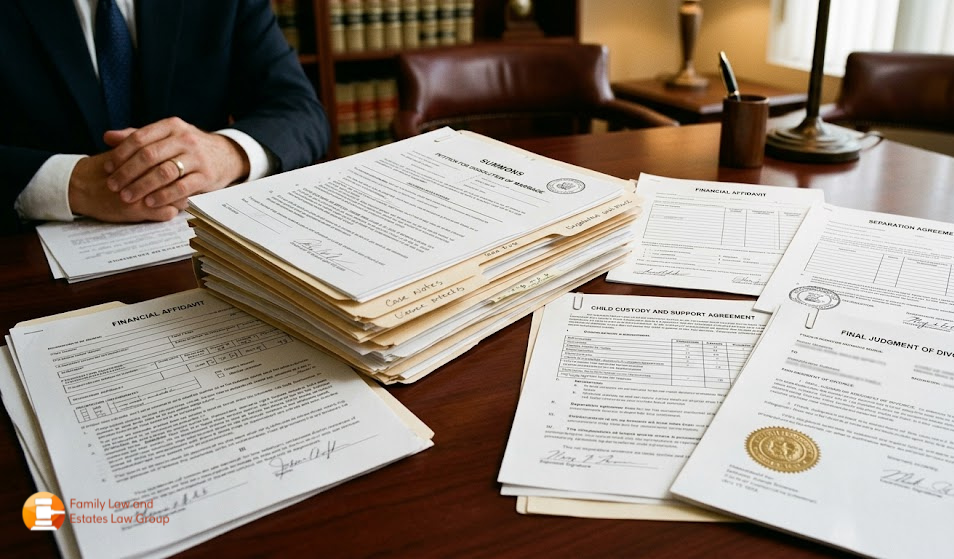
Dividing up property is one of the toughest parts of a divorce. It often causes the most stress. When a marriage ends, couples have to figure out what to do with everything from their homes and retirement accounts to debts and business interests. If you're trying to understand how property gets divided during a divorce, it's crucial to know how the law distinguishes between marital and separate property, how courts value things, and why having solid legal and financial paperwork is so important.
In California, the rules for dividing property in a divorce are based on community property principles. These might seem straightforward at first, but things get complicated when assets are mixed, businesses come into play, or retirement benefits need to be sorted out. For many families, this process is also tied to decisions about support and parenting. So, working with a trusted family law team and checking out related topics like how divorce affects your finances can help you see the big picture early on. Marriage and household finances have evolved a lot over time, and the legal system keeps adapting as families accumulate more diverse assets. For a broader look at divorce trends, the U.S. Department of Health and Human Services offers demographic data at CDC FastStats.
What Property Division Means in a Divorce
Marital property versus separate property
The first step in dividing property is figuring out what belongs to the marriage and what belongs to one spouse alone. Marital, or community, property usually includes assets and debts acquired during the marriage. Separate property generally includes things owned before marriage, gifts made to one spouse alone, inheritances, and certain assets protected by agreement. This classification matters because it often determines whether the item is divided or kept by one spouse.
This distinction sounds simple, but real cases often aren't. A house bought before marriage might become partly marital if community funds paid down the mortgage. A business started before the wedding might grow dramatically during the marriage, creating both separate and shared interests. These questions are why property division cases often require a careful review of bank statements, tax returns, appraisals, and records showing when and how property was acquired.
Community property and equitable distribution
Most people hear that divorces are either based on community property or equitable distribution. Community property states generally treat property acquired during the marriage as jointly owned, often dividing it equally. Equitable distribution states focus on fairness rather than a strict 50/50 split. That doesn't always mean equal, because courts can weigh income, the duration of the marriage, contributions by each spouse, and future financial needs.
California follows a community property system, which makes accurate classification especially important. If you want to understand how this plays out in practice, the rules for asset division are closely tied to your documents and financial history. Our divorce law guidance can help you prepare for settlement discussions and court proceedings with a clearer strategy. For a legal overview of property division frameworks, the Cornell Legal Information Institute has a useful explanation of marital property concepts at Cornell LII.
How Courts Value and Classify Assets
Why valuation is so important
Before property can be divided, it has to be valued. Courts and attorneys look at homes, retirement plans, vehicles, investment portfolios, business interests, personal property, and debts to determine what the estate is actually worth. If one spouse understates an asset or ignores a liability, the division may be unfair and vulnerable to challenge.
Valuation is especially important for assets that fluctuate in value or that don't have an obvious market price. A retirement account may need a qualified domestic relations order, or QDRO, to divide it correctly. A business may need a forensic accountant to assess goodwill, revenue, liabilities, and future earning potential. The goal is to place a fair number on each asset so the final division reflects the true financial picture.
Documentation and tracing
Courts often rely on tracing to figure out whether an asset is separate, community, or mixed. Tracing means following the money from its source to its current form. This matters when someone brings premarital savings into a marriage, inherits funds, or deposits separate and marital money into the same account. If records are incomplete, a court may presume the property is community property.
That's why detailed documentation is so valuable. Keep statements, deeds, loan records, pay stubs, tax filings, retirement summaries, and any paperwork showing the source of funds. If you're gathering records now, our guide to preparing key divorce documents can help you organize what matters most. In difficult tracing disputes, financial records and expert analysis can make a big difference. Government guidance on consumer financial records is available through the CFPB.
Common Assets and Debts in Divorce Cases
The family home
The family home is often the most emotionally important asset in a divorce. It may also be the most financially significant. The court will consider how the home was acquired, whether it was purchased before or during the marriage, whether separate funds were used for the down payment, and whether mortgage payments were made with community income. If one spouse wants to keep the house, that spouse may need to refinance or offset the other spouse’s equity with another asset.
Many couples also have to decide whether selling the home is more practical than trying to preserve it. A sale may simplify division, pay off shared debt, and reduce future conflict. But if children are involved or one spouse cannot qualify for financing alone, a different arrangement may be needed. A related issue is whether home equity should be balanced against retirement assets or other property to create an equitable overall settlement.
Retirement accounts and pensions
Retirement accounts are frequently among the largest assets in divorce. 401(k) plans, IRAs, pensions, and public retirement benefits may all be divided differently depending on the account type and the governing plan rules. Even if an account is in one spouse’s name only, contributions made during the marriage may still be subject to division.
Because these assets often involve tax consequences and special procedural rules, professional guidance is important. A divorce settlement that overlooks a retirement account can create long-term financial harm. If retirement assets or estate issues are part of your planning, it may also make sense to review wills and trust planning so your post-divorce documents match your new circumstances. For retirement plan division basics, the U.S. Department of Labor explains QDRO requirements at dol.gov.
Debts, credit cards, and loans
Property division isn't only about assets. Debts matter just as much. Credit cards, personal loans, car loans, tax obligations, and medical bills may all need to be divided depending on when they were incurred and for what purpose. In community property states, debts acquired during the marriage are often considered shared obligations, even if only one spouse signed the account.
That's why separating finances early can be so helpful. Closing joint accounts, monitoring credit reports, and listing all debts can prevent surprise claims later. If a spouse used marital funds for a personal purchase or a new relationship expense, that spending may become relevant in settlement negotiations. Clear records often reduce the chances of expensive disputes over who owes what.
Complex and High-Value Asset Division
Business interests and professional practices
When a marriage includes a business, property division becomes more complex. The court may need to determine the business’s value, whether it was started before marriage, and how much growth occurred during the marriage. Even if only one spouse ran the business, the other spouse may have a claim to a portion of the value if marital labor, income, or funds helped build it.
Professional practices, such as medical, legal, or consulting practices, can be even more difficult because the value may include tangible assets, client relationships, and goodwill. In these situations, an appraiser or forensic accountant may be necessary. The court wants a fair division, not a guess, and that often means understanding both the current worth and the ongoing income stream the business generates.
Commingled assets and asset tracing
Commingling happens when separate and marital property are mixed in a way that makes them hard to distinguish. For example, if an inheritance is deposited into a joint account and used for household spending, tracing becomes essential. If separate property can't be identified clearly, the court may treat more of it as marital property. This is one reason commingled assets frequently lead to conflict.
The importance of tracing is highlighted in many cases, including California decisions that stress transaction-by-transaction analysis when separate and community funds have been mixed. The best defense against confusion is documentation. That means keeping account histories, deposit records, and proof of the source of funds. If you're already in a property dispute, strong evidence can protect your position and reduce the risk of losing a separate-property claim.
Case examples that show how courts think
Real-world cases show how much courts care about fairness, proof, and proper classification. In Macy v. Macy, the Nebraska Court of Appeals emphasized fairness and reasonableness over rigid formulas in dividing property. That approach reflects a broader judicial concern: the final result should reflect the facts, not a one-size-fits-all formula. Courts often look at the full financial story, not just isolated account balances.
In Marriage of Simonis, a California court applied strict tracing requirements and concluded that failure to perform detailed tracing left the community property presumption in place. This kind of case is a reminder that good records can shape the outcome. When a spouse can't prove separate ownership, the court may divide the property in a way that would have been avoidable with better documentation. For more legal background on this issue, see the framework discussed in this analysis of classification rules.
How California Divorce Property Division Works
Why California is different
California’s community property rules make property division especially important for divorcing spouses in the state. In general, assets and debts acquired during marriage are presumed to belong equally to both spouses unless an exception applies. This can be a powerful advantage for a spouse who stayed home or contributed in non-financial ways, but it can also lead to complicated claims when one spouse owned property before the marriage or received inherited funds.
Because California law emphasizes equal division of community property, disputes often center on what counts as community property in the first place. That’s why working with an attorney who understands local practice can be so valuable. If your case involves a business, house, or retirement accounts in California, our real estate law support may also help when title, ownership, or property-transfer questions arise.
Spousal support, child support, and property division
Property division doesn’t happen in isolation. Spousal support and child support can affect settlement strategy, especially when one spouse receives more property in exchange for lower monthly support. Courts look at the overall financial result, not just one category at a time. That means a person may accept a larger share of retirement assets, for example, in exchange for less cash today or a different support arrangement.
If parenting issues are also part of your case, reviewing child custody law can help you understand how financial decisions interact with parenting time and stability for the children. In many divorces, parents are trying to preserve housing, school routines, and support structures while also dividing property fairly. The legal and practical decisions often move together.
Best Practices for Protecting Your Financial Future
Start with a complete asset and debt inventory.
The most effective divorce cases begin with complete information. Make a list of every account, property, business interest, debt, and recurring obligation. Include approximate values, account numbers, and whether the item was acquired before or during the marriage. The more complete your inventory is, the easier it is to spot hidden issues and negotiate from a position of knowledge.
This is also a good time to gather tax returns, pay stubs, insurance policies, and estate documents. Many people are surprised by how much a single missing statement can affect the valuation of an asset. If you need help finding your next step, our legal resources page offers practical support materials that can help you prepare for consultation and court deadlines.
Work with financial and legal professionals
Property division is rarely just a legal issue. Financial experts may need to value businesses, retirement accounts, stock options, and complex investments. Accountants can help trace funds and identify tax consequences. A skilled family law attorney can then turn that financial information into a settlement strategy or courtroom argument.
This professional support is especially important in high-conflict or high-asset divorces. The Legal Services Corporation estimates that its grantees handle about 80,000 divorce, separation, and annulment cases annually, which shows just how many families need help navigating these issues. For a broader background on access to legal help, see the academic discussion at Springer. When the stakes are high, good advice can protect both short-term stability and long-term wealth.
Consider mediation and settlement options.
Many property disputes are resolved outside of trial through negotiation or mediation. Mediation gives spouses a chance to design a settlement that reflects family priorities, tax concerns, and practical realities. It can be especially useful when both sides want to preserve privacy or reduce conflict.
If you are preparing for that process, it can help to read about legal separation versus divorce and the role of family law mediation in resolving disputes. These resources can help you think through whether a negotiated settlement is the right path for your circumstances. A well-prepared mediation often leads to faster and more durable results than a contested court fight.
Frequently Asked Questions About Divorce Property Division
What happens if one spouse hides assets?
If a spouse hides assets, the court can impose penalties, adjust the division, or reopen the case if the concealment is discovered later. Hidden assets may include unreported bank accounts, cash, cryptocurrency, bonus income, or property transferred to friends or relatives. Discovery tools, subpoenas, and financial experts are often used to uncover these issues.
Transparency is not just a legal requirement; it is also a practical one. If the court believes a spouse was dishonest, that behavior can damage credibility in the entire case. Full disclosure is usually the safest route, even when the numbers are uncomfortable.
Can property division be changed after the divorce?
Generally, once a property division is finalized, it is difficult to change. That’s why reviewing settlement terms carefully before signing is so important. Some post-judgment corrections may be possible if there was fraud, a mistake, or a missed asset, but those situations are limited. Preventing problems during the negotiation stage is much easier than trying to fix them later.
Before finalizing anything, make sure you understand how the property settlement fits with support, taxes, and long-term planning. If you are also thinking about what happens to your estate after divorce, coordinate with estate planning services so beneficiary designations and documents remain consistent with your new life.
How are personal items divided?
Furniture, jewelry, art, collectibles, and household items are often divided either by agreement or by value. While these items may not seem as significant as a home or pension, they can become emotional flashpoints. One practical solution is to assign values and alternate selections until the total balance is fair.
For items with sentimental value, many couples find that a negotiated trade works better than a strict sale. The goal is not only mathematical fairness but also a settlement that both people can live with after the divorce ends. That approach can save money, reduce conflict, and avoid unnecessary court time.
Final Thoughts: Build a Fair Division With the Right Support
Why does preparation change the outcome?
Understanding how property is divided during a divorce gives you more control over a difficult process. When you know the difference between separate and community property, understand how assets are valued, and keep careful records, you are far better positioned to protect what matters most. The law may be technical, but good preparation makes it manageable.
Divorce is not only about ending a marriage. It’s about reorganizing a financial life, often under emotional pressure and time constraints. The more complete your information is at the start, the more likely you are to reach a fair result without unnecessary conflict.
Get guidance tailored to your situation.
Every divorce is different, and property division should reflect the facts of your family, your assets, and your goals. If you need help understanding your rights, organizing your documents, or negotiating a settlement, the right legal team can make the process clearer and less overwhelming. Our firm serves individuals and families who need careful, strategic support during major life transitions, and we are committed to helping clients move forward with confidence.
To speak with an experienced attorney about divorce property division, contact Family Law and Estates Law Group, P.C. at (818) 996-6563 or visit our website. If you are ready to protect your financial future, start by getting organized, asking the right questions, and seeking guidance that is focused on your goals.